Last updated 2026-08-17
TL;DR
Yes, you need a license to inspect for asbestos in Alabama. ADEM runs the program under EPA AHERA rules. You need a 3-day (24-hour) accredited inspector course, a passing exam, and a state accreditation fee. First-year cost runs $400 to $900 depending on course and fees. Confirm current fees with ADEM before applying.
Do you need a license to inspect for asbestos in Alabama?
Yes. You cannot legally conduct asbestos inspections in Alabama without state accreditation. Alabama runs its asbestos program through the Alabama Department of Environmental Management (ADEM), which accredits asbestos professionals under the federal Asbestos Hazard Emergency Response Act (AHERA) and EPA's Model Accreditation Plan (MAP) at 40 CFR Part 763, Subpart E [1].
The federal MAP sets a floor. Anyone who inspects for asbestos in a school or public building must hold valid accreditation from a state-approved program, or directly from EPA if the state has no approved plan [2]. Alabama has an approved plan, so ADEM issues the accreditation, not EPA.
There's no grandfathering shortcut. You complete the training, pass the exam, and get the accreditation certificate from ADEM before you touch a building professionally. Work without it and you're exposed to ADEM enforcement and federal AHERA penalties. The liability risk is real and not worth testing.
Aside from schools, Alabama applies AHERA-based accreditation to commercial and public building inspections under related state rules, so the same credential covers most of that work. Residential single-family homes sit in a different regulatory category, but many clients and contractors still want an accredited inspector on those too. Get the credential before you take clients.
What federal rules set the baseline for Alabama's requirements?
EPA's AHERA regulations at 40 CFR Part 763, Subpart E built the national framework in 1987 and have been updated since [1]. The Model Accreditation Plan inside those rules spells out what training must cover, how long it must run, and what the exam must test. Any state that adopts an EPA-approved plan has to meet or exceed the MAP. Alabama meets it through ADEM.
The key MAP requirement for inspectors is a 3-day initial course totaling at least 24 contact hours, followed by a closed-book exam [2]. Passing scores and exam mechanics are set by the accredited training provider, subject to EPA oversight.
EPA's rule at 40 CFR 763.90 requires that inspections in school buildings be done by "accredited inspectors," and that accreditation come from either a state with an EPA-approved plan or from EPA directly [1]. Alabama has that approved plan. That's why you go through ADEM.
Refresher training is a MAP requirement too. Inspectors have to complete an annual 8-hour refresher to keep accreditation, and skipping even one year means starting over with the full 24-hour initial course [2]. Plan for that cost. It bites people who forget.
What training do you need to get an Alabama asbestos inspector license?
The initial requirement is a 24-hour (3-day) inspector course from an EPA-accredited training provider [2]. The course covers asbestos identification, sampling technique, federal and state rules, health effects, and a hands-on component. You cannot substitute online-only instruction for the whole thing. The MAP requires hands-on sampling practice.
After the course, you sit a closed-book written exam given by the training provider. EPA's MAP does not set a single national passing score, leaving that to each accredited provider under state oversight, but most set it at 70% correct [2].
Training providers have to be EPA-approved themselves. Not every company advertising asbestos training is actually accredited to issue MAP-compliant certificates, so verify accreditation status before you pay tuition. EPA maintains program information on asbestos training and accreditation [3].
Once you have the training certificate, you file for state accreditation with ADEM. The training certificate is not the state license. It's the document that lets you apply for ADEM accreditation [4].
Thinking about adding Inspector/Management Planner to your scope at the same time? The Management Planner discipline needs a separate 16-hour course, but AHERA lets providers bundle it with the inspector course into one package. That combined path is more efficient if you plan to write management plans. The AsbestosPath AHERA + Management Planner Kit walks through what that training covers and what to look for in a provider.
How do you apply for Alabama ADEM asbestos accreditation?
After you finish the accredited course and pass the exam, you submit an application to ADEM's Air Division, which handles asbestos professional accreditation for the state [4]. The package generally includes your original training certificate, a completed application form, and the accreditation fee. ADEM publishes its own forms and current fee schedule; confirm both before submitting, because they change.
ADEM assigns an accreditation number and issues a wallet card or certificate you carry on inspections. You must have that documentation available during any inspection. Leaving it in the car or at the office is a compliance issue.
Processing time varies. ADEM does not publish a guaranteed turnaround, and it moves with application volume. Two to four weeks after ADEM receives a complete application is a reasonable planning estimate, but confirm with ADEM directly since it can run longer in busy periods [4].
Know your expiration date from day one. ADEM accreditations run on annual cycles tied to your training date, and the renewal deadline does not wait for you. Miss it by a day and your accreditation technically lapses and needs re-verification.
How long does it take to get an Alabama asbestos inspector license?
From zero to licensed, most people finish in 5 to 10 weeks. Here's how the time breaks down.
The initial 24-hour course runs 3 consecutive days, sometimes spread across a week depending on the provider [2]. Exam results are usually same-day or within a few days. Your training certificate should land within 1 to 2 weeks of finishing the course.
ADEM review adds time on top. Two to four weeks is the common estimate, but the actual window depends on staffing and submission volume. ADEM advertises no expedited option, so you can't pay to jump the line [4].
| Step | Typical Duration |
|---|---|
| Find and schedule accredited training | 1 to 2 weeks |
| Complete 24-hour course | 3 days |
| Receive training certificate | 1 to 2 weeks |
| Submit ADEM application | 1 to 3 days |
| ADEM review and issuance | 2 to 4 weeks |
| Total (realistic) | 5 to 10 weeks |
Need the credential for a specific project start date? Back-plan from that date and add a buffer. You can rush the training side if you find a course starting soon, but the ADEM processing window is the piece you don't control.
How much does an Alabama asbestos inspector license cost?
First-year cost lands in the $400 to $900 range for most applicants. That spread is real, and it depends on choices you make. Here's where the money goes.
The 24-hour initial course is the biggest line item. Accredited providers typically charge $300 to $600 for the inspector course [3]. Providers in or near Alabama sit inside that band. Online-only components may be priced separately from the hands-on day. Travel and lodging add to it if no provider is nearby.
The ADEM accreditation fee is set by the state. Confirm the current number directly with ADEM, because state fee schedules get updated and third-party sites go stale [4]. Recent ADEM fee schedules have run roughly $50 to $200 per discipline, but verify before you budget.
Annual renewal needs the 8-hour refresher course, usually $100 to $200 a year [2], plus the ADEM renewal fee. That's your ongoing overhead after year one.
There are no separate exam fees paid to ADEM. The exam is part of the training provider's course package. Some providers fold materials into tuition. Others charge separately for study guides or printed handouts.
What are Alabama's ongoing requirements after you get licensed?
Keeping your Alabama accreditation takes two things every year: the 8-hour annual refresher course and on-time renewal with ADEM [2][4].
The refresher must come from an EPA-accredited provider, same as the initial course. You don't have to use the same provider. Many inspectors book the refresher in the same month each year so they don't miss the window. The MAP is blunt about the penalty for missing it: a lapsed accreditation means retaking the full 24-hour initial course, not catching up on missed refreshers [2]. That's a hard rule and an expensive mistake.
Renewal paperwork and fees go to ADEM before your accreditation expires. ADEM may send a renewal notice, but relying on that is a bad habit. Track your own expiration date.
Beyond the credential, inspectors working in Alabama have to follow AHERA inspection protocol: bulk sampling minimums per homogeneous area, chain-of-custody documentation, and reporting for school inspections under 40 CFR 763.85 [1]. Inspection reports have to be kept on file and available for review. EPA can and does audit school asbestos records.
Expand into other AHERA disciplines later (Management Planner, Project Designer, Contractor/Supervisor, Abatement Worker) and each one needs its own training and separate ADEM accreditation. Related, but not interchangeable.
How does Alabama compare to nearby states for asbestos inspector licensing?
Alabama runs a mid-tier program compared to its neighbors. It meets federal MAP minimums and doesn't pile on much state-specific overhead beyond what AHERA demands. That makes it a straightforward state to get licensed in, unlike states such as California that stack extra certifications, surety bond requirements, and DTSC oversight on top of the EPA baseline.
| State | Oversight Agency | Initial Training | Annual Refresher | Notes |
|---|---|---|---|---|
| Alabama | ADEM | 24 hours (MAP) | 8 hours | AHERA-aligned, no surety bond required |
| Arkansas | ADEQ | 24 hours (MAP) | 8 hours | Similar structure to Alabama |
| Georgia | EPD | 24 hours (MAP) | 8 hours | State accreditation required |
| Mississippi | MDEQ | 24 hours (MAP) | 8 hours | Uses EPA MAP directly |
| California | DTSC / Cal/OSHA | 24 hours + Cal-specific | 8 hours | Additional state requirements |
For the neighboring state comparison, see the asbestos inspector license in Arkansas and asbestos inspector license in Arizona guides.
The practical takeaway: licensed in Alabama and want to work in another southeastern state? You still apply for that state's accreditation separately. There's no formal interstate reciprocity for asbestos inspector licenses, though your Alabama training certificate documents the coursework, and most states accept it as proof of training.
What does an Alabama asbestos inspector actually do day to day?
The core job is finding suspect asbestos-containing material (ACM) in buildings, collecting bulk samples, and writing reports that inform management decisions. Under AHERA, schools have to be inspected by accredited inspectors every 3 years, with 6-month periodic surveillance in between [1]. That cycle creates steady demand in any state with a big school building inventory.
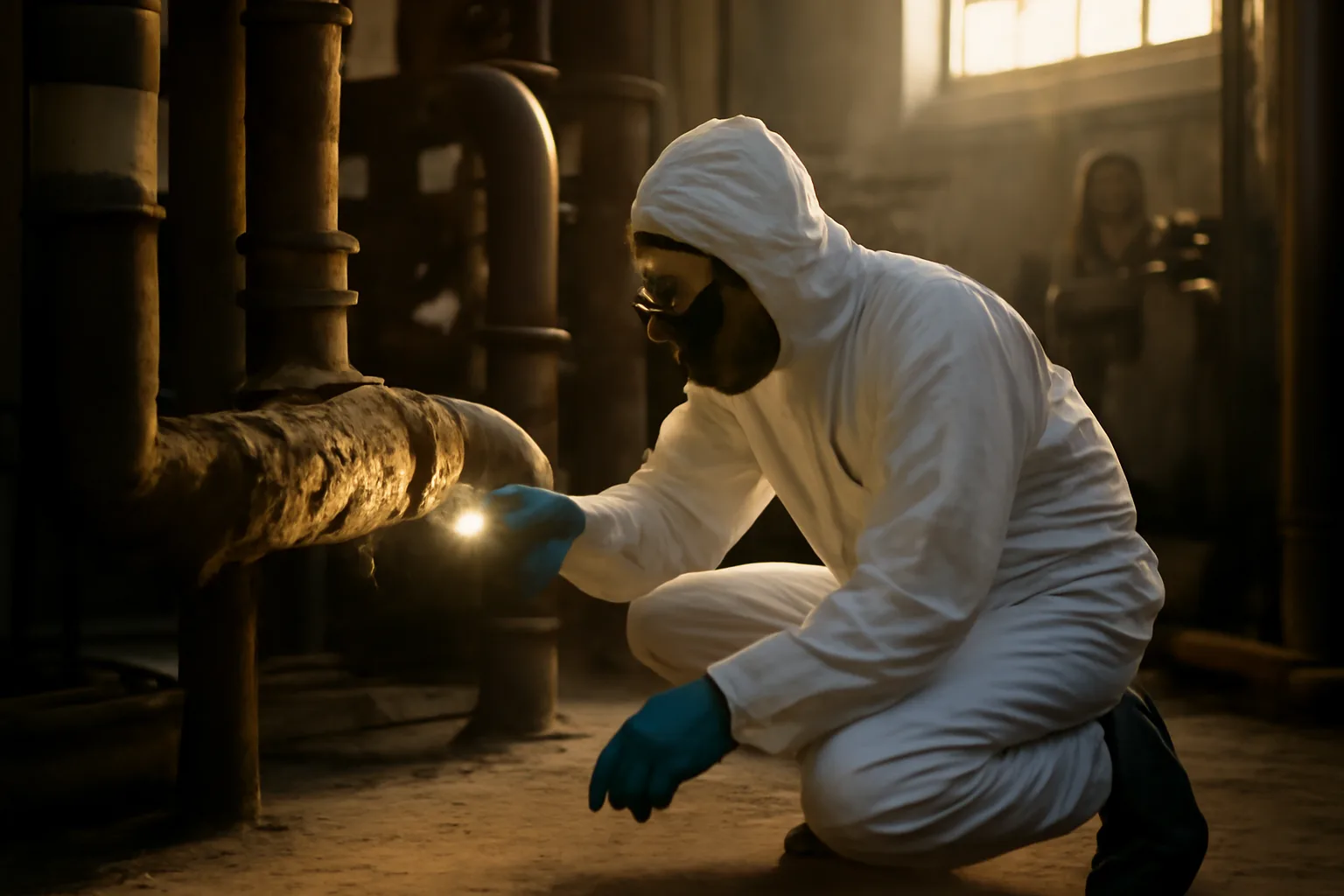
On a typical inspection day, you walk a building systematically, identify homogeneous areas of suspect material (floor tile, ceiling tile, pipe insulation, joint compound, and so on), and decide how many samples each area needs under 40 CFR 763.86 [1]. You collect bulk samples in proper PPE, label them for chain of custody, and ship them to an accredited laboratory for polarized light microscopy (PLM) analysis.
When lab results come back, you write a report documenting every homogeneous area assessed, the friability and condition of any ACM found, and your recommendations. For schools, that report becomes the core of the asbestos management plan the school is legally required to maintain.
Commercial and industrial inspections outside the school context follow similar sampling protocols but often get triggered by renovation or demolition under NESHAP (40 CFR Part 61, Subpart M) [5]. Different regulatory trigger, same inspector skills.
The work is methodical. You need a good eye for building materials, comfort in mechanical rooms and above ceiling tiles, and the discipline to document everything correctly. A sloppy report puts the building owner and your license on the line.
Where can you find accredited asbestos inspector training in Alabama?
EPA maintains program information on AHERA-accredited training and accreditation, and ADEM maintains provider information at the state level [3][4]. Check both before you enroll.
Several regional companies serve Alabama and the southeastern U.S., running in-person 3-day inspector courses in Birmingham, Huntsville, and Mobile, plus hybrid formats where some regulatory content runs online before a hands-on sampling day. Confirm any hybrid format is accepted by ADEM before enrolling, because ADEM's read on the hands-on requirement matters for your application.
National providers also schedule courses across the region. Costs at these providers typically fall in the $300 to $500 range for the inspector course [3].
Planning to earn both Inspector and Management Planner? The combined course (usually 5 days total) is more economical than two separate enrollments. A solid AHERA inspector and management planner study kit, like the one AsbestosPath offers at /start for $199, gets you up to speed on the regulatory framework before you walk into the training room, which matters for passing the exam on the first try.
For a broader look at building your Alabama practice from scratch, the how to start asbestos inspector in Alabama guide covers business setup, liability insurance, and finding your first clients.
What happens if you inspect without a license in Alabama?
ADEM has enforcement authority under Alabama's environmental statutes and can assess civil penalties for unauthorized asbestos inspection work. On the federal side, AHERA violations carry civil penalties that EPA adjusts for inflation each year, and the base statutory penalty runs up to $5,000 per day under 15 U.S.C. 2647, adjusted upward over time [6].
For school inspections, the fallout spreads past the inspector. Schools that use unaccredited inspectors violate AHERA and face their own penalty exposure. So sophisticated school clients will ask for your accreditation before they let you in the door. Any school that doesn't is taking a serious compliance risk.
Practically, your report is worthless without accreditation. Labs will still run your samples, but a report signed by an unaccredited inspector cannot satisfy an AHERA requirement. The work gets redone by an accredited inspector, and you've burned everyone's time and money.
Insurance is the other piece. General liability and errors and omissions (E&O) policies for environmental consultants usually require the insured to hold all required professional credentials. An unaccredited inspector who triggers a claim can find coverage denied. That's not a theoretical risk.
Frequently asked questions
Do you need a license for asbestos inspector in Alabama?
Yes. Alabama requires state accreditation from ADEM for anyone doing professional asbestos inspections. The accreditation is issued under ADEM's asbestos program, which follows EPA AHERA and the Model Accreditation Plan at 40 CFR Part 763. Working without it exposes you to state and federal penalties. The credential is separate from any business license you need to operate as a consultant.
How much does an asbestos inspector license cost in Alabama?
Budget $400 to $900 for the first year. The 24-hour initial course is typically $300 to $600 depending on the provider. ADEM's accreditation fee is an additional charge; confirm the current amount directly with ADEM before applying, since fees are updated periodically. Annual renewal after year one needs an 8-hour refresher course ($100 to $200) plus the ADEM renewal fee.
How long does it take to get an asbestos inspector license in Alabama?
Realistically, 5 to 10 weeks from start to credential in hand. The 24-hour course takes 3 days. Your training certificate usually arrives 1 to 2 weeks after the course. ADEM then takes roughly 2 to 4 weeks to process a complete application, though that window can stretch in high-volume periods. There's no publicly advertised expedited option. Confirm current processing times with ADEM when you apply.
What training is required to become an accredited asbestos inspector in Alabama?
A 24-hour initial inspector course from an EPA-accredited training provider, followed by a closed-book written exam. The course has to include hands-on bulk sampling practice; online-only instruction does not satisfy the MAP requirement. After initial accreditation, you complete an 8-hour refresher course every year to keep it. Skipping even one year means repeating the full 24-hour initial course.
Which agency issues asbestos inspector accreditation in Alabama?
ADEM, the Alabama Department of Environmental Management, administers asbestos professional accreditation through its Air Division. Alabama operates under an EPA-approved state plan, so ADEM rather than EPA directly issues accreditation. The application, fees, and renewal all go through ADEM. Contact ADEM's Air Division for current application forms and fee schedules before submitting anything.
Does Alabama accept asbestos inspector licenses from other states?
No formal reciprocity agreement exists. If you hold accreditation from another state, your training certificate documents your coursework, and most states accept that as proof of completed training. But you still apply for ADEM accreditation separately and pay Alabama's fee. You generally do not have to retake the full initial training if your existing certificate is current and from an EPA-accredited provider.
How often do you need to renew an Alabama asbestos inspector license?
Annually. Alabama asbestos inspector accreditations run on a one-year cycle tied to your training date. Renewal needs an 8-hour annual refresher course from an EPA-accredited provider plus renewal paperwork and fees submitted to ADEM before expiration. Miss the deadline and your accreditation lapses. A lapsed accreditation means restarting with the full 24-hour initial course, not catching up.
What exam do you take to become an asbestos inspector in Alabama?
The exam is a closed-book written test given by your training provider at the end of the 24-hour course. There's no separate state exam from ADEM. EPA's Model Accreditation Plan requires the exam but leaves passing score thresholds to accredited providers under state oversight. Most providers set the passing score at 70%. Check with your specific provider before the course.
Can I inspect asbestos in Alabama schools without a license?
No. AHERA explicitly requires inspections in school buildings to be done by accredited inspectors under 40 CFR 763.85. Schools have to keep inspection records and can be audited by EPA. Using an unaccredited inspector puts both the school and the inspector at risk of federal penalties. Accreditation is not optional for school inspection work.
Does ADEM accreditation cover both schools and commercial buildings?
Generally yes. ADEM's asbestos inspector accreditation, issued under the AHERA-aligned state program, covers inspections in schools and public or commercial buildings. Residential single-family homes sit in a different regulatory category and are not subject to the same AHERA inspection requirements, though many residential clients still request accredited inspectors. Confirm with ADEM if you have questions about a specific building type.
What is the difference between an asbestos inspector and a management planner in Alabama?
An inspector identifies and samples suspect asbestos-containing material. A management planner takes the inspector's findings and writes the formal asbestos management plan a school is required to maintain. They are separate AHERA disciplines with distinct training: 24 hours for inspector, 16 additional hours for management planner. Both need separate ADEM accreditation, though many professionals hold both.
What laboratory analyzes asbestos samples collected during an Alabama inspection?
Samples go to a laboratory accredited by NVLAP (National Voluntary Laboratory Accreditation Program) under the EPA AHERA program. Polarized light microscopy (PLM) is the standard method for bulk samples. Transmission electron microscopy (TEM) is used in specific situations. NVLAP maintains a searchable list of accredited labs on the NIST site. Using a non-NVLAP lab makes your results non-compliant with AHERA.
Does Alabama require a bond or insurance to get an asbestos inspector license?
ADEM's accreditation program for individual inspectors does not appear to require a surety bond as part of the application, unlike some states. But if you operate as a consulting firm, clients and contracts often require general liability and professional E&O insurance. Confirm current ADEM application requirements directly with ADEM, since requirements can change, and review any client contracts for their own insurance minimums.
Where can I find EPA-accredited asbestos inspector training near Alabama?
EPA maintains program information on asbestos training and accreditation. Several regional providers run in-person courses in Birmingham, Huntsville, and Mobile, and others serve the southeastern U.S. on rotating schedules. Confirm any provider is currently EPA-accredited before enrolling. Hybrid formats that combine online content with a hands-on day may or may not satisfy ADEM's requirements; verify with ADEM directly before choosing that format.
Sources
- EPA, 40 CFR Part 763 Subpart E (AHERA): AHERA inspection and accreditation requirements for schools, including that inspections must be conducted by accredited inspectors and sampling minimums per homogeneous area under 40 CFR 763.85 and 763.86
- EPA, AHERA Model Accreditation Plan, 40 CFR Part 763 Appendix C to Subpart E: MAP requires 24-hour initial inspector course with hands-on component, closed-book exam, and annual 8-hour refresher; lapsed accreditation requires full initial course
- EPA, Asbestos Laws and Regulations (AHERA): EPA maintains information on AHERA training and accreditation requirements for asbestos professionals
- Alabama Department of Environmental Management (ADEM), Air Division Asbestos Program: ADEM administers asbestos professional accreditation in Alabama under the state's EPA-approved plan, including application procedures and fee schedules
- EPA, National Emission Standards for Hazardous Air Pollutants (NESHAP), 40 CFR Part 61 Subpart M: NESHAP Subpart M regulates asbestos in renovation and demolition projects, requiring inspections that trigger asbestos inspector involvement outside the school AHERA context
- AHERA, 15 U.S.C. 2647 (Enforcement): AHERA enforcement provision sets civil penalties for violations, which EPA adjusts for inflation over time
- NIST NVLAP, National Voluntary Laboratory Accreditation Program: NVLAP accredits laboratories for asbestos bulk sample analysis; AHERA requires PLM analysis by NVLAP-accredited labs