Last updated 2026-08-17
TL;DR
Alabama requires anyone who inspects for asbestos in schools and most commercial buildings to hold a state-issued accreditation through the Alabama Department of Environmental Management (ADEM), which runs the federal AHERA framework. Initial training is 24 hours over 3 days, plus a roughly 4-hour refresher every year. State fees and processing times change, so confirm current figures with ADEM before you apply.
Do you need a license to work as an asbestos inspector in Alabama?
Yes. Alabama makes asbestos inspectors get accredited under the state program that ADEM runs on authority delegated from EPA's Asbestos Hazard Emergency Response Act (AHERA). That delegation means Alabama sets its own paperwork and fees, but the federal floor never drops away.
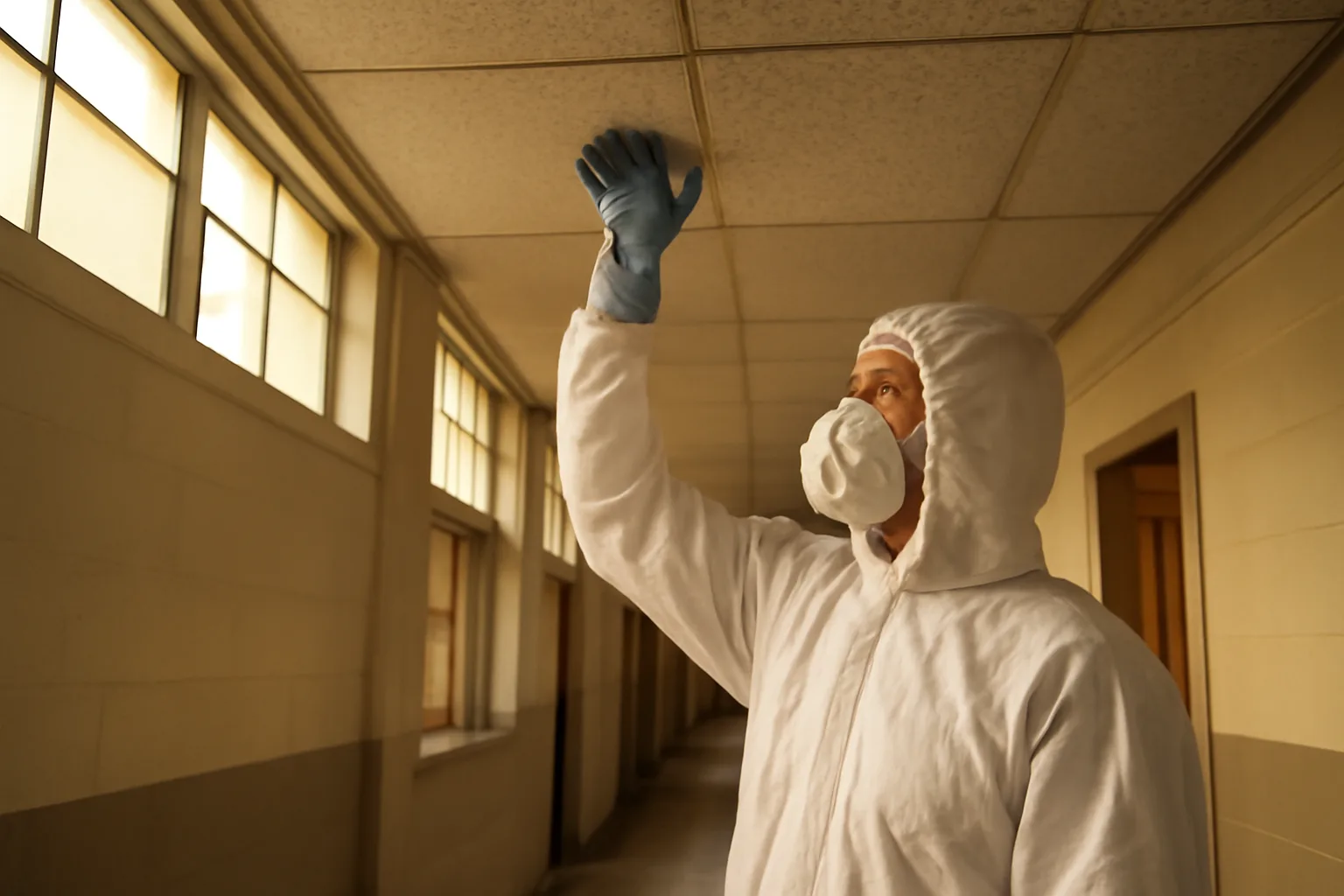
Here's the short version. Inspect a school building or a public or commercial structure for asbestos-containing material (ACM) in Alabama, and you need a current ADEM accreditation card in your name before you set foot on site. Skip it, and you put yourself, your employer, and the building owner in front of EPA and ADEM enforcement. [1][2]
Private single-family homeowners fall outside AHERA, so inspections in purely private residential settings sit in a gray zone. Most working inspectors carry accreditation anyway, because they can't always control where a job goes. If you're chasing any commercial or school work, treat the card as non-negotiable.
Alabama's enabling authority sits inside the Alabama Environmental Management Act, and ADEM's asbestos rules live in Alabama Administrative Code Chapter 335-3. [3] The office that handles all of it is ADEM's Air Division, which processes asbestos accreditation and project notifications.
What board or agency issues asbestos inspector credentials in Alabama?
There's no stand-alone asbestos inspector board in Alabama. The single issuing authority is the Alabama Department of Environmental Management, Air Division. [3]
ADEM sits in Montgomery. One unit reviews your training certificates, processes your application, issues your accreditation card, and tracks renewals. If your application goes sideways, ADEM is who you call. No separate board of examiners. No trade board. No secondary review panel.
EPA keeps oversight in the background. Under AHERA, EPA can step in if a state program drops below federal standards, but Alabama's program is approved and running. [1] Your Alabama ADEM accreditation satisfies the federal AHERA requirement for school inspections inside Alabama. It does nothing for you across a state line, so confirm reciprocity before you take an out-of-state job.
What are Alabama's AHERA training requirements for inspectors?
The federal AHERA rule, at 40 CFR Part 763 Subpart E Appendix C, sets the training floor Alabama has to meet or beat. For the Inspector discipline, that's a 3-day (24-hour) accredited course covering building inspection procedures, sampling, recordkeeping, and the regulations. [4]
EPA's model accreditation plan puts it plainly: the inspector course "must include a minimum of 24 hours of training." [4] Alabama follows that floor. Your course has to come from a provider accredited by a state with an EPA-approved program. Courses from unaccredited providers count for nothing.
After initial accreditation, refresher training comes due every year. The AHERA inspector refresher is a half-day course, roughly 4 hours. Miss it and your accreditation lapses, which means retaking the full 24-hour initial course instead of a short refresher. That's a real cost. Set a calendar reminder well before your anniversary date.
Plenty of inspectors take the Management Planner course (another 3 days, 24 hours) at the same time as the inspector course, because the two disciplines run together and the combined training costs less than two separate enrollments. If you ever plan to write O&M plans or advise on response actions, stacking both from the start saves time and money. The AsbestosPath AHERA + Management Planner Kit walks through what the combined coursework actually covers before you commit to a provider.
How much does it cost to become an asbestos inspector in Alabama?
Three cost layers: training, the state application fee, and ongoing renewals. None of them are trivial, and the total is manageable if you budget all three up front.
Training is priced by the course provider, not by ADEM or the state. A 3-day initial inspector course usually runs $400 to $800 nationwide depending on provider, location, and whether materials are included. Alabama residents can find regional providers in Birmingham, Huntsville, or Mobile, or take an approved course in Georgia or Tennessee. [2]
State application fees are set by ADEM and change over time. Confirm the exact current amount straight from ADEM before you send payment, because fee schedules get updated and old PDFs go stale. [3] Don't trust a number you found in a forum.
Renewal fees follow the same ADEM schedule on an annual cycle tied to your expiration date.
Here's a realistic cost picture using public data and typical market ranges. Treat the training and fee figures as estimates until you get current quotes.
| Cost item | Typical range | Notes |
|---|---|---|
| Initial inspector training (24 hrs) | $400 to $800 | Provider-set; confirm with accredited provider |
| Management planner add-on (24 hrs) | $400 to $700 | Often bundled with inspector course |
| ADEM accreditation application fee | Confirm with ADEM | Per discipline; subject to change |
| Annual refresher course (4 hrs) | $100 to $250 | Provider-set |
| Annual renewal fee | Confirm with ADEM | Per discipline |
Training is the biggest variable. A bundled inspector-plus-management-planner course usually costs less than two separate courses, and you walk away with two disciplines on one card. [4][5]
How long does it take to get accredited as an asbestos inspector in Alabama?
Two phases run the clock: the training window and the ADEM processing window.
Training is fixed by federal rule at a minimum of 24 hours over 3 days. You can't compress it. Providers schedule courses on set dates, so your first constraint is finding an open seat near Alabama. Depending on the season, that's 2 to 4 weeks out, or 6 to 8 weeks if the next class is full. Summer books up faster than winter.
Finish training, then submit your application and certificates to ADEM. ADEM doesn't publish a guaranteed turnaround. State agency processing for professional accreditation in similar programs generally runs 2 to 6 weeks, but that's a rough guide, not an ADEM promise. Confirm current processing times with ADEM before you commit to a project start date. [3]
Plan 6 to 12 weeks from decision to card in hand. That window covers course scheduling, the 3 days of instruction, and ADEM's review. Need it faster? Call ADEM early and ask whether expedited review exists.
One delay shows up over and over: incomplete submissions. ADEM sends back any application missing a training certificate, a payment, or a required form, and that restart costs weeks. Walk the application packet checklist line by line before you mail or upload anything.
How do you apply for asbestos inspector accreditation in Alabama?
ADEM's asbestos accreditation follows a standard path, though exact form numbers and submission methods should always be confirmed on ADEM's current website, because processes get updated.
The general steps:
1. Finish an accredited AHERA inspector training course from a provider approved by an EPA-recognized state program. 2. Get your original training certificate from the provider. ADEM wants this documentation. 3. Download and complete ADEM's current asbestos accreditation application. Alabama has historically accepted applications by mail to its Montgomery office. Confirm whether online or email submission is now available. 4. Include proof of training (original or certified copy of your training certificate). 5. Include payment for the applicable fee. Confirm accepted payment methods with ADEM. 6. Send the complete package to ADEM's Air Division.
ADEM reviews the package, checks that your training provider is on the approved list, and issues the accreditation card when everything checks out. [3] The card lists your name, discipline (inspector), accreditation number, and expiration date. Keep it on you for every inspection job.
Applying for Management Planner at the same time? Submit both disciplines on one packet. You pay per discipline but only run the paperwork once.
What does the Alabama accreditation card actually authorize you to do?
Your inspector accreditation lets you enter buildings, visually assess suspect materials, collect bulk samples of suspect ACM, and write the inspection report AHERA requires. That report is the base for everything downstream: O&M programs, response actions, abatement bids, and management plans all flow from a valid inspector's findings. [1][4]
The card does not let you design or manage abatement projects or write formal management plans. Those need separate AHERA disciplines, Project Designer and Management Planner. Plenty of working inspectors hold several disciplines. If your business includes advising on response strategy, you need the Management Planner credential.
One thing inspectors get wrong: collecting samples is in scope, but analyzing them is a different job. You need a NVLAP-accredited laboratory to run your bulk samples. [5] Your card doesn't make you a lab analyst.
Chasing Georgia or Florida jobs alongside Alabama work? Check each state's program. See how Georgia handles this and how Florida structures its requirements, because neither state hands you automatic reciprocity with Alabama.
How do annual renewals and continuing education work in Alabama?
Alabama runs on the federal AHERA refresher rule: inspectors complete a half-day (roughly 4-hour) refresher course every year to keep their accreditation. [4] The refresher updates you on rule changes, drills sampling and safety protocols, and resets your accreditation clock.
Refreshers must come from accredited providers, same rule as initial training. A refresher from a non-approved provider counts for nothing. ADEM won't accept a certificate from an unrecognized course.
Your accreditation has a fixed expiration date tied to when it was issued. Complete the refresher and submit your renewal to ADEM before that date. Don't wait for the last week. If your accreditation lapses, even by a day, most state programs treat it as expired and make you retake the full 3-day initial course instead of the refresher. That's an expensive way to learn about calendar reminders.
Set two: one 90 days out to schedule the refresher course, one 45 days out to submit renewal paperwork and fee to ADEM. That buffer absorbs seat availability and ADEM's processing time.
What happens if you inspect without accreditation in Alabama?
Inspect in Alabama without a valid ADEM accreditation and you open the door to federal and state enforcement. EPA carries civil penalty authority under AHERA and the Clean Air Act's NESHAP asbestos standard. Penalties can reach thousands of dollars per violation per day. [1][6]
ADEM has its own state enforcement authority under the Alabama Environmental Management Act. [3] A building owner who hired an unaccredited inspector can face penalties too, because using one violates AHERA's school requirements and many state commercial building requirements.
The legal exposure isn't even the whole problem. Your inspection report has no regulatory standing. A school district or building owner can't use an inspection done by an unaccredited inspector to satisfy AHERA's triennial inspection requirement. They pay for a legitimate inspection again, and they'll likely come after you for the cost.
If your accreditation lapses mid-project, stop sampling. Don't finish the job and backdate paperwork. Call ADEM, explain what happened, and find out your options. Covering it up makes everything worse.
Is Alabama's program different from neighboring states?
In structure, Alabama's ADEM-run program looks a lot like Georgia, Tennessee, Mississippi, and Florida, because they all come from the same federal AHERA framework. The 24-hour initial inspector course and the annual refresher are federal floors no state can undercut. [4]
States split apart on fee schedules, application forms, renewal timing, and any state-specific add-ons layered on top of the federal floor. Alabama has kept its program close to the federal baseline without big extras, but check ADEM's current rules rather than assume a neighbor's experience maps onto Alabama exactly.
Reciprocity is the other variable. Some state pairs recognize each other's accreditations for specific disciplines. Alabama doesn't run a published reciprocity agreement covering all disciplines. Need to work in Arizona, Arkansas, Illinois, or California? Confirm that state's current reciprocity or endorsement process with the issuing agency directly. Your Alabama card doesn't travel on faith.
Curious how other southeastern programs compare on cost and structure? Georgia's program and Florida's program are a reasonable starting point, since both states have higher job volume and slightly different fee histories.
Where to get prep materials and what AsbestosPath offers
EPA standardizes the AHERA inspector training content, so the core curriculum matches across accredited providers. What varies is how they teach it, how well their materials explain real sampling technique, and how current their regulatory updates are.
Want to get oriented before your formal course, or prep for the Management Planner discipline alongside your inspector accreditation? AsbestosPath's $199 AHERA + Management Planner Kit at asbestospath.com/start covers the documentation, regulatory framework, and practical concepts behind both disciplines. It's a reference kit, not a substitute for an accredited provider course, and it doesn't replace ADEM's process. Walking into a 3-day course having already worked through the management planner concepts means you absorb the live instruction faster.
EPA also maintains free public resources on AHERA, including the full regulatory text, the model accreditation plan, and state program contacts. Bookmark those before you apply.
Frequently asked questions
Do you need a license for asbestos inspector in Alabama?
Yes. Alabama requires asbestos inspectors to hold a current accreditation issued by the Alabama Department of Environmental Management (ADEM). The accreditation is built on federal AHERA requirements under 40 CFR Part 763. Working without it exposes you to federal and state penalties, and reports from unaccredited inspectors have no regulatory standing. Confirm current requirements with ADEM before applying.
How much does asbestos inspector cost in Alabama?
Budget three layers: training (typically $400 to $800 for the 3-day initial inspector course), an ADEM application fee (confirm the exact current amount with ADEM), and annual refresher plus renewal costs (refreshers run $100 to $250). Adding Management Planner in a bundled course saves money over two separate enrollments. Total first-year cost commonly runs $700 to $1,500 depending on training provider.
How long does asbestos inspector take in Alabama?
Training is a federally mandated minimum of 24 hours over 3 days. After the course, you submit your application to ADEM for processing. Realistically, plan 6 to 12 weeks from decision to accreditation card, accounting for course scheduling and ADEM's review. Confirm current ADEM processing times directly with the agency before planning a project start date, since no official processing guarantee is published.
Which agency oversees asbestos inspector accreditation in Alabama?
The Alabama Department of Environmental Management (ADEM), Air Division, administers the asbestos accreditation program. There is no separate asbestos inspector board in Alabama. ADEM operates under authority delegated from EPA's AHERA program. All applications, fee payments, and renewal paperwork go to ADEM in Montgomery.
How many training hours does Alabama require for an asbestos inspector?
Alabama follows the federal AHERA minimum of 24 hours of instruction over 3 days for initial inspector accreditation. Annual renewal requires a half-day (roughly 4-hour) refresher course. Both the initial course and the refresher must come from an accredited training provider. Miss your annual refresher and you lose the accreditation and must retake the full 24-hour course.
What is AHERA and why does it matter for Alabama inspectors?
AHERA stands for Asbestos Hazard Emergency Response Act, a 1986 federal law requiring EPA to regulate asbestos in school buildings. EPA's implementing rule (40 CFR Part 763) set accreditation requirements for inspectors, management planners, and abatement workers. Alabama adopted an EPA-approved state program that mirrors AHERA. Your Alabama ADEM accreditation satisfies the federal AHERA inspector requirement for work inside Alabama.
Can I use my Alabama asbestos inspector accreditation in other states?
Not automatically. There is no universal reciprocity between state asbestos programs. Each state runs its own AHERA-based accreditation system. To work in Georgia, Florida, Tennessee, or anywhere else, contact that state's issuing agency about endorsement or reciprocity. Some states have informal agreements; others require a full application. Never assume your Alabama card is valid out of state without confirming.
What happens if my Alabama asbestos inspector accreditation lapses?
If your accreditation expires, you cannot legally conduct AHERA inspections until it's reinstated. In most AHERA-based programs, a lapsed accreditation forces you to retake the full 24-hour initial inspector course rather than just the annual refresher. That means paying for a 3-day course again. Contact ADEM immediately if yours has lapsed to understand your reinstatement options before taking on any inspection work.
Do I need a separate license to collect asbestos bulk samples in Alabama?
Bulk sampling during an inspection is within the scope of your inspector accreditation. You do not need a separate sampling-only license for that activity. But the laboratory analyzing your samples must be accredited under NVLAP (National Voluntary Laboratory Accreditation Program) for asbestos bulk analysis. Your inspector card does not authorize you to run laboratory analysis yourself.
Does Alabama require asbestos inspections for residential homes?
AHERA's accreditation requirements apply to school buildings and, through state programs, to commercial and public buildings. Single-family private residences generally fall outside AHERA. Even so, many inspectors carry accreditation for residential work because clients expect it and a job can shift in scope. If you plan to inspect any non-residential property in Alabama, the accreditation is required.
Where can I find an AHERA-accredited training provider near Alabama?
EPA maintains an online list of state asbestos training accreditation programs. From there, you can contact ADEM or other accredited states for lists of approved providers. Regional providers serving Alabama often sit in Birmingham, Huntsville, Mobile, or nearby Georgia and Tennessee. Confirm any provider's approval status before enrolling, since a course from a non-approved provider means your certificate won't be accepted.
Can I get the Management Planner accreditation at the same time as my inspector accreditation in Alabama?
Yes, and it often makes sense to do both at once. Management Planner also requires a 3-day (24-hour) initial course, and many providers offer a combined inspector-plus-management-planner course that runs 5 days and costs less than two separate enrollments. You submit a single application to ADEM listing both disciplines. Having both on your card widens the scope of work you can legally perform.
How do I contact ADEM's asbestos accreditation program?
Contact ADEM's Air Division directly. The mailing address is Alabama Department of Environmental Management, Air Division, P.O. Box 301463, Montgomery, AL 36130-1463. The main line is (334) 271-7700. Confirm the specific asbestos accreditation contact and current application forms on ADEM's website at adem.alabama.gov before submitting anything, since contact details and forms are updated periodically.
Is there an exam I need to pass to become an accredited asbestos inspector in Alabama?
AHERA's model accreditation plan requires that training courses include a written examination at the end of the initial course. Passing that exam, administered by the training provider, is part of earning your training certificate. Alabama follows this requirement. ADEM does not administer a separate state exam; your training provider exam certificate is what you submit with your ADEM application. Confirm exam passing requirements with your chosen provider before enrolling.
Sources
- EPA, Asbestos Laws and Regulations: AHERA requires accreditation for asbestos inspectors working in school buildings and establishes EPA oversight of state accreditation programs.
- EPA, Asbestos and School Buildings: EPA recognizes and reviews state asbestos accreditation programs; Alabama's ADEM program operates under EPA delegation.
- EPA, 40 CFR Part 763 Subpart E Appendix C: Model Accreditation Plan: The federal model accreditation plan requires a minimum 24-hour initial inspector training course and approximately 4-hour annual refresher for AHERA inspector accreditation.
- NIST, National Voluntary Laboratory Accreditation Program (NVLAP): Bulk asbestos samples collected during inspections must be analyzed by a NVLAP-accredited laboratory, not by the inspector.
- EPA, Asbestos NESHAP (National Emission Standards for Hazardous Air Pollutants): EPA has civil penalty authority under the Clean Air Act NESHAP asbestos standard for violations including use of unaccredited inspectors.
- EPA, AHERA Regulations 40 CFR Part 763 Subpart E: 40 CFR Part 763 Subpart E establishes the federal AHERA framework that Alabama's ADEM program implements, including inspector accreditation requirements.
- Alabama Environmental Management Act, Code of Alabama Title 22 Chapter 22A: Alabama's environmental enforcement authority, including authority over asbestos accreditation violations, derives from the Alabama Environmental Management Act.
- EPA, Managing Asbestos in Schools: AHERA requires school buildings to be inspected by accredited inspectors; Alabama schools must comply through ADEM-accredited professionals.